Feature Channels
Nanotechnology
Filters:
ScienceChannels: |
Silicon-Based Nanoparticles Could Make LEDs Cheaper, Greener to ProduceResearchers at the University of Washington have created a material they say would make LED bulbs cheaper and greener to manufacture, driving down the price. Their silicon-based nanoparticles soften the blue light emitted by LEDs, creating white light that more closely resembles sunlight. |
Released: 6/12/2013 5:00 PM EDT
University of Washington |
ScienceChannels:Keywords: |
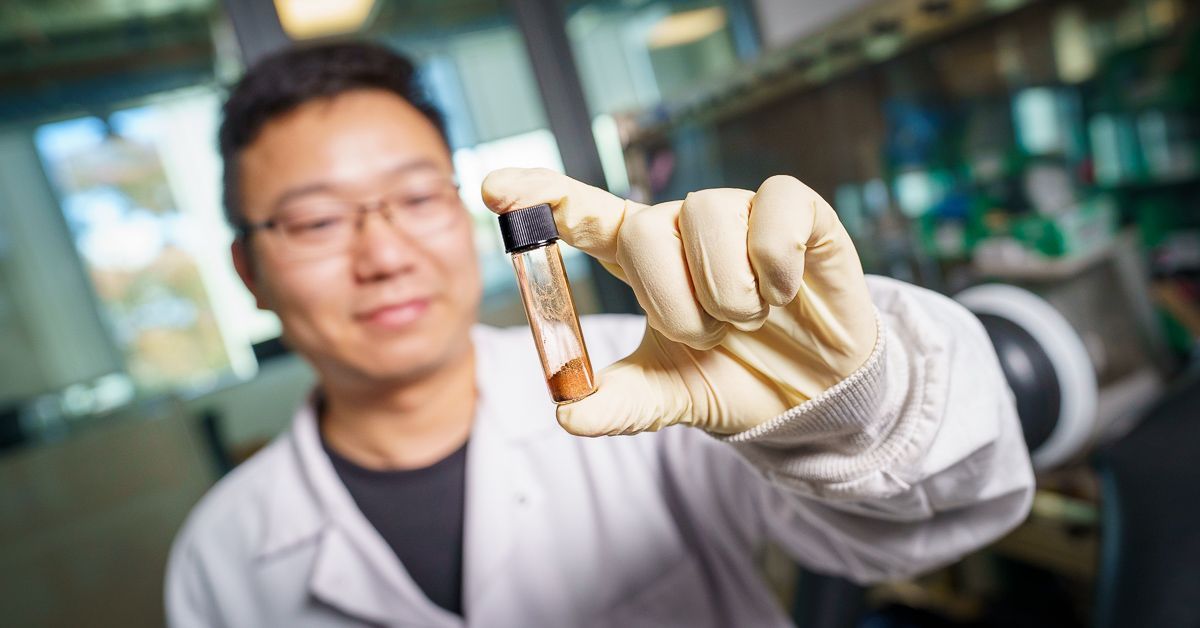
Exposure to Air Transforms Gold Alloys Into Catalytic Nanostructures
Brookhaven Lab scientists create promising gold-indium oxide nanoparticles through room-temperature oxidation |
Released: 6/11/2013 3:30 PM EDT
Brookhaven National Laboratory |
ScienceChannels:Keywords: |
Polymer Nanoreactors Create Uniform Nanocrystals
Using star-shaped block co-polymer structures as tiny reaction vessels, researchers have developed an improved technique for producing nanocrystals with consistent sizes, compositions and architectures – including metallic, ferroelectric, magnetic, semiconductor and luminescent nanocrystals. |
Released: 6/11/2013 12:55 PM EDT
Georgia Institute of Technology |
ScienceChannels:Keywords: |
“Popcorn” Particle Pathways Promise Better Lithium-Ion Batteries
Researchers at Sandia National Laboratories have confirmed the particle-by-particle mechanism by which lithium ions move in and out of electrodes made of lithium iron phosphate (LiFePO4, or LFP), findings that could lead to better performance in lithium-ion batteries in electric vehicles, medical equipment and aircraft. The research is reported in the journal Nano Letters, 2013, 13 (3), pp 866-872. |
Released: 6/11/2013 7:00 AM EDT
Sandia National Laboratories |
MedicineScienceChannels:Keywords: |
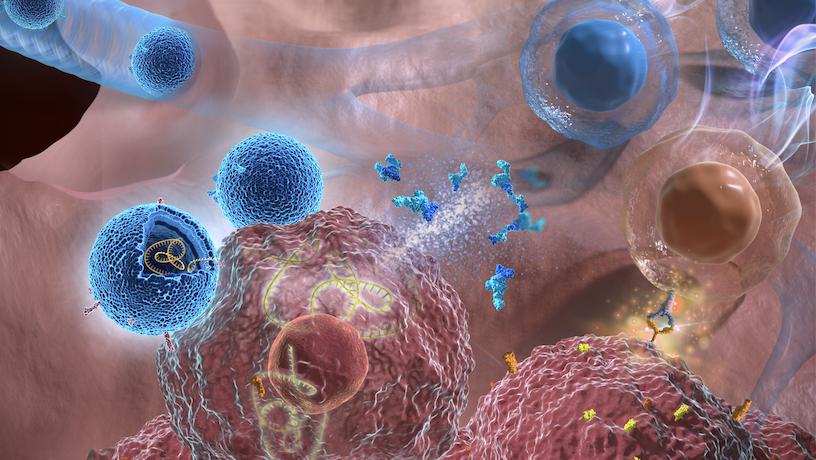
Shape of Nanoparticles Points the Way Toward More Targeted DrugsA collaboration of scientists at Sanford-Burnham and the University of California, Santa Barbara, finds that rod-shaped particles, rather than spherical particles, appear more effective at adhering to cells where they’re needed. |
Embargo expired: 6/10/2013 3:00 PM EDT
Released: 6/10/2013 11:00 AM EDT
Sanford-Burnham Medical Research Institute |
ScienceChannels:Keywords: |
Spintronics Approach Enables New Quantum Technologies
A team of researchers including members of the University of Chicago’s Institute for Molecular Engineering highlight the power of emerging quantum technologies in two recent papers published in the Proceedings of the National Academy of Sciences (PNAS). |
Released: 6/4/2013 2:45 PM EDT
University of Chicago |
ScienceChannels:Keywords: |
Even with Defects, Graphene Is Strongest Material in the World
Columbia Engineering researchers demonstrate that graphene, even if stitched together from many small crystalline grains, is almost as strong as graphene in its perfect crystalline form. This resolves a contradiction between theoretical simulations, which predicted grain boundaries can be strong, and earlier experiments, which indicated they were much weaker than the perfect lattice. |
Released: 5/31/2013 12:00 PM EDT
Columbia University School of Engineering and Applied Science |
ScienceChannels:Keywords: |
Innovative New Nanotechnology Stops Bed Bugs in Their Tracks - Literally
Bed bugs now need to watch their step. Researchers at Stony Brook University have developed a safe, non-chemical resource that literally stops bed bugs in their tracks. This innovative new technology acts as a man-made web consisting of microfibers 50 times thinner than a human hair which entangle and trap bed bugs and other insects. This patent-pending technology is being commercialized by Fibertrap, a private company that employs non-toxic pest control methods. |
Released: 5/30/2013 2:00 PM EDT
Stony Brook Medicine |
ScienceChannels:Keywords: |
Fastest Measurements Ever Made of Ion Channel Proteins
Columbia Engineering researchers have used miniaturized electronics to measure the activity of individual ion-channel proteins with temporal resolution as fine as one microsecond, producing the fastest recordings of single ion channels ever performed. |
Released: 5/23/2013 4:00 PM EDT
Columbia University School of Engineering and Applied Science |
ScienceChannels:Keywords: |
Atomic-Scale Investigations Solve Key Puzzle of LED Efficiency
MIT and Brookhaven Lab scientists use electron microscopy imaging techniques to settle a solid-state controversy and raise new experimental possibilities |
Released: 5/23/2013 4:00 PM EDT
Brookhaven National Laboratory |